Your wrapped vehicle is out there every day. On the road, in car parks, pulling up outside customer premises. Done well, it's one of the most effective forms of advertising your business can invest in.
But a vehicle wrap is only as good as the design behind it.
Not just whether it looks good on screen, but whether it's been properly built for the vehicle it's going on.
That means professionally designed panel by panel, around the actual shape of the vehicle, and prepared correctly for print and installation, not just an AI-generated image.
Getting the design right isn't just about the output from a prompt. Sure, it’ll have your colours, your brand and your vehicle. But it won't be print-ready, nor will it be designed to get the most out of your vehicle.
Our guide to how panel placement affects the final look of your vehicle wrap covers this in more detail.
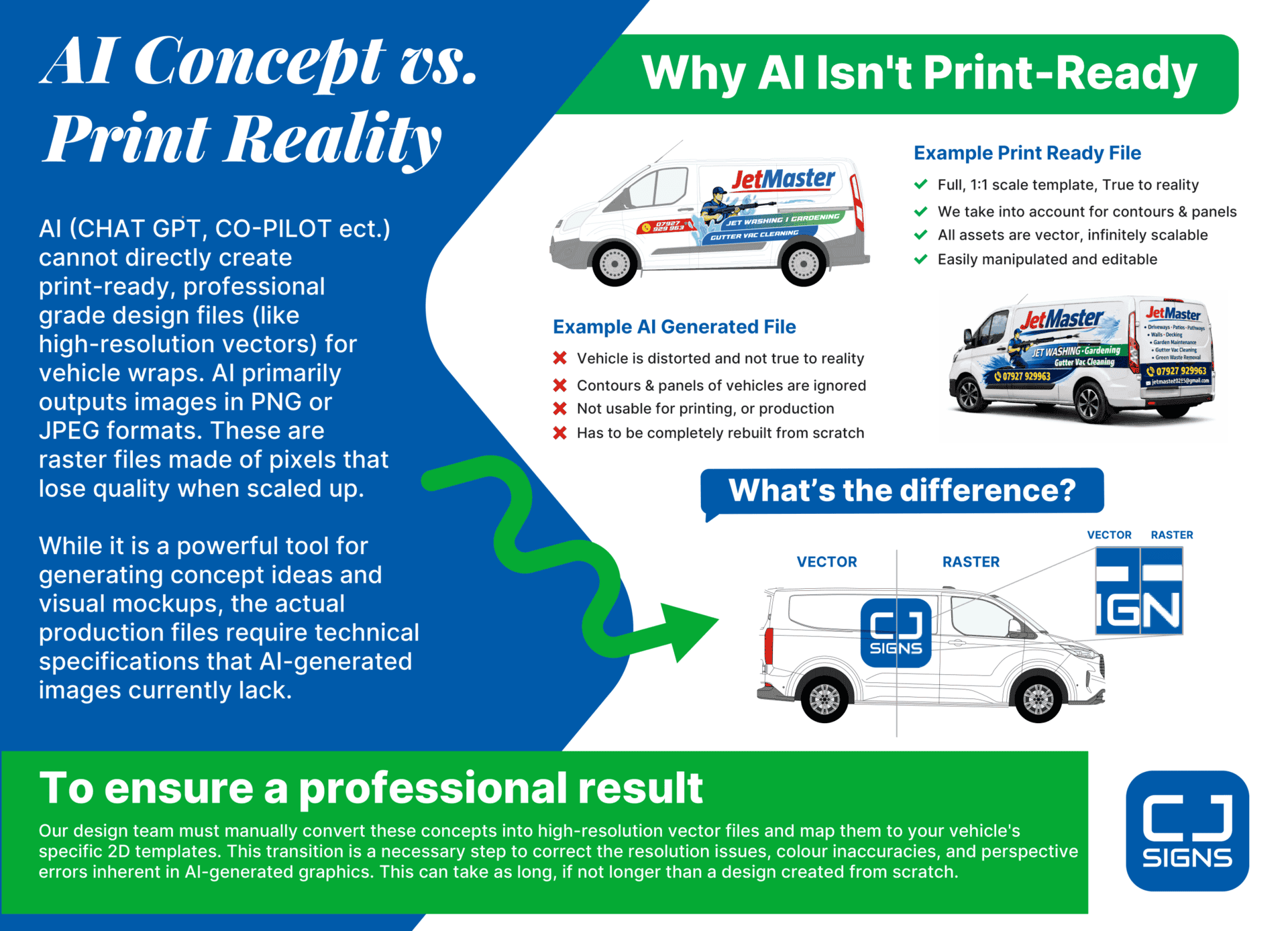
We're seeing more customers come to us with designs created in AI image tools. Yes, they look good, the style is right, the colours work and the branding feels consistent. But unfortunately, it isn't a vehicle wrap design. It's an image.
A vehicle wrap has to be built on an accurate, scaled template for the specific vehicle it's going on, accounting for every panel, recess and seam. An AI-generated image has none of that. It's a flat graphic, usually at the wrong dimensions, with no relationship to the actual surfaces it needs to cover.
So before it can be used, it needs to be rebuilt. Redrawn and remapped to the correct vehicle template, by someone who understands both the brand and how vinyl sits on that vehicle. In most cases, starting from a proper brief is quicker than trying to work backwards from an AI image.
For mood-boarding, exploring an idea, or giving us a feel for what you're after, they can be really handy, but they’re a starting point, not a finished design.
A proper wrap design isn't just a generated image, it's a technical file that tells us exactly where everything goes and how it relates to the specific vehicle.
Vehicle-specific templates. Every design we produce is built on an accurate template for the specific make, model and variant.
Panel mapping. Every graphic element is positioned deliberately, against the actual panels of the vehicle. Logos and text go on flat, visible surfaces. Nothing ends up over a handle recess, across a sharp curve, or on a panel seam where it'll split or distort.
The wrap type. A full wrap, a part wrap, and a graphics job each need a different approach. The design logic is different for each.
How it reads on the road. It's easy to approve a design that looks great on screen at full zoom. What matters is how it reads at speed, from a distance, in different light. Text size, contrast and layout are all considered against the real-world conditions the vehicle is seen in.
Print-ready files. Large-format print needs high-resolution, properly scaled assets. Web-quality images, or anything pulled straight from an AI output, won't hold up properly. It shows immediately once installed, and there's no fixing it after the fact.
An AI-generated image is a flat graphic. It has no relationship to the vehicle it needs to go on. It hasn't been built to any template, it isn't sized correctly for large-format print, and it hasn't accounted for a single panel, seam, recess or handle on your specific van, truck or car.
A vehicle wrap design is a technical file. It tells the installer exactly where everything goes and how it sits across the actual surfaces of the vehicle. Getting from one to the other isn't a small step, and it isn't something that can be skipped.
Bring references, not finished files. Your logo, brand guidelines, wraps you like the look of, and a clear sense of what you want to get across. That's a solid starting point. Finished AI artwork or designs produced outside the vehicle graphics industry will almost always need some rework.
Tell us about the vehicle. Make, model, variant and base colour all affect the design. The more detail the better.
Design is part of the process. At CJ Signs, every wrap includes design. We don't install artwork that hasn't been properly prepared, because the finished result is a reflection of our work as much as it is of the business we're wrapping for.
There are also legal requirements to be aware of. Number plates, lights, mirrors and certain safety markings can't be covered by vinyl. A properly prepared design accounts for all of this from the start. Our guide to van signage rules covers what you need to know..
A well-designed, properly installed vehicle wrap will represent your business every day for five to seven years. That's a lot of miles, a lot of roads, and a lot of eyes on your brand.
The design is what determines whether that works for you.
For more on how the full process works, from brief through to fitting, take a look at our guide to the vehicle wrapping process.
Or if you're ready to get started, get in touch for a free quote. We design and install every wrap in-house from our workshop near Junction 31 of the M1, covering Sheffield, Chesterfield, Barnsley, Doncaster and across South Yorkshire.